
CSIR NET PHYSICS JUNE 2025
21 AUGUST, 202611:33 AM
Previously live

CSIR NET Physics / Physical Sciences – Complete Information
CSIR NET Physical Sciences
The Joint CSIR-UGC NET is one of India's most important national-level examinations for students and researchers in science. For Physics students, the examination is conducted under the Physical Sciences subject.
CSIR NET Physical Sciences is primarily aimed at determining eligibility for:
Junior Research Fellowship (JRF)
Assistant Professor
Admission to Ph.D. programmes, according to the applicable category and university/institution rules
The examination is conducted by the National Testing Agency (NTA) in Computer Based Test (CBT) mode. CSIR-HRDG states that the examination is generally conducted twice a year, usually in the June and December cycles.
Why Should You Prepare for CSIR NET Physics?
CSIR NET Physics is an excellent option for students who want to build a career in:
Qualifying for JRF can provide an important pathway toward doctoral research and a research career.
CSIR NET Physics Eligibility Criteria
1. Educational Qualification
Candidates with a relevant Master's degree or equivalent qualification are generally eligible.
For General/Unreserved/General-EWS candidates, a minimum of 55% marks in the Master's degree or equivalent examination is required.
Candidates belonging to OBC-NCL, SC, ST, PwD and Third Gender categories generally require a minimum of 50% marks.
2. Final-Year / Result-Awaited Students
Students who are:
Pursuing their Master's degree,
Appearing in the final examination, or
Awaiting their qualifying examination result
may also apply provisionally, subject to fulfilling the prescribed qualification requirements within the stipulated period.
3. Four-Year Bachelor's Degree Route
Candidates who have completed a 4-year/8-semester Bachelor's degree with the required marks may also be eligible for JRF and Ph.D. admission under the applicable regulations.
The current CSIR-HRDG guidelines specify 75% aggregate marks for this route, with applicable relaxation for specified categories.
Candidates qualifying through a four-year undergraduate degree are eligible for JRF and Ph.D. admission, but are not eligible for appointment as Assistant Professor through this route.
CSIR NET Physics Age Limit
For Junior Research Fellowship (JRF)
The upper age limit for JRF is currently 30 years, calculated according to the date specified in the applicable examination notification.
Age relaxation of up to 5 years is available to eligible categories such as:
Additional provisions may apply for candidates with eligible research experience or armed-forces service, subject to the prescribed conditions.
For Assistant Professor
There is no upper age limit for applying for CSIR-UGC NET for Assistant Professor eligibility.
For Ph.D. Admission
There is no upper age limit for CSIR-UGC NET for admission to Ph.D., subject to the applicable eligibility rules.
Note: Candidates should always verify age and qualification requirements from the Information Bulletin of the particular examination cycle before applying.
CSIR NET Physics Exam Pattern
CSIR NET Physical Sciences is a single-paper examination conducted in CBT mode.
Examination Details
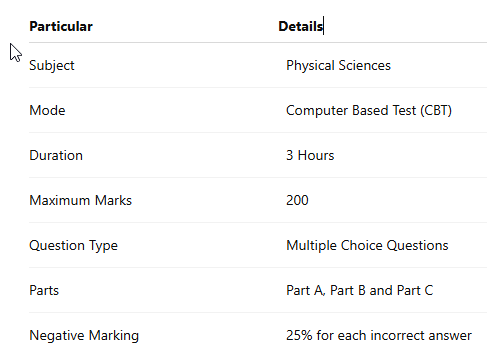
The official Physical Sciences scheme specifies the following structure.
Part A – General Aptitude
Total Questions: 20
Questions to Attempt: 15
Marks per Question: 2
Maximum Marks: 30
Part A tests areas such as:
General Science
Quantitative Reasoning
Logical/Analytical Reasoning
Research Aptitude
Part B – Core Physical Sciences
Total Questions: 25
Questions to Attempt: 20
Marks per Question: 3.5
Maximum Marks: 70
Part B primarily tests conceptual understanding of the core Physical Sciences syllabus.
Part C – Advanced / Analytical Physics
Total Questions: 30
Questions to Attempt: 20
Marks per Question: 5
Maximum Marks: 100
Part C contains higher-level and analytical questions that require application of Physics concepts and mathematical techniques.
Negative Marking
There is 25% negative marking for an incorrect answer in Physical Sciences.
Therefore, candidates should avoid blind guessing and develop good question-selection skills.
CSIR NET Physics Important Topics
For effective preparation, students should give special attention to:
A strong command of Mathematics is particularly useful because many Part C questions require multi-step mathematical analysis.